
An Ayatollah Decapitated
Intelligence Fusion, Persistent Surveillance, and the Architecture of Contemporary Power

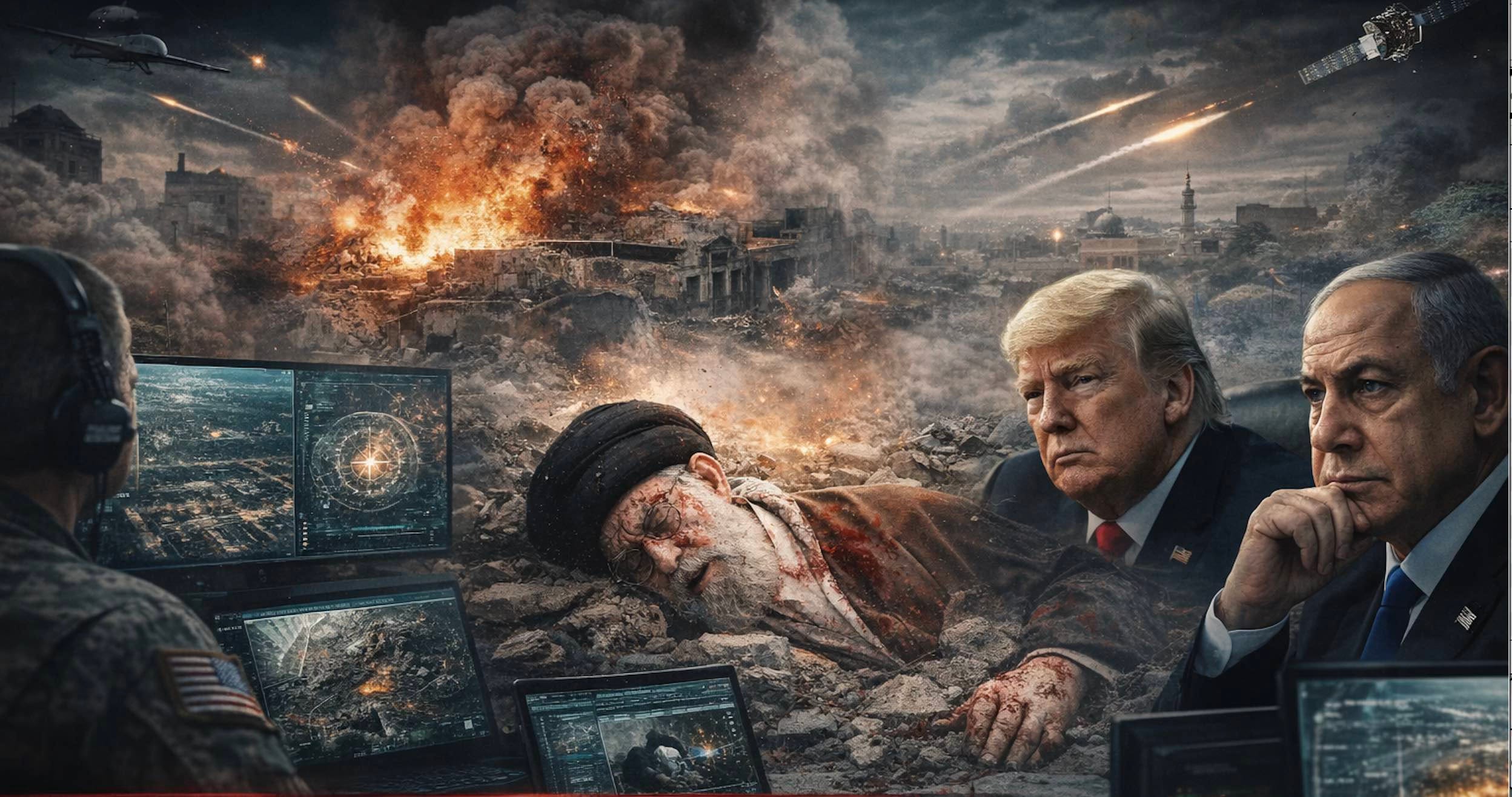
On 28 February 2026, power manifested not only through spectacle but through timing. The strike that killed the Ayatollah Ali Khamenei did not begin with the launch of missiles. It began with the detection of a deviation from routine. There was a sudden convergence of senior aides. The Islamic Republic’s most protected figure had quietly gathered his inner circle at a single site. In a state built on secrecy and compartmentalisation, concentration is vulnerability. The logic is old. What has changed is the speed and resolution at which concentration can be detected, verified, and exploited.
Later public statements emphasised precision and intelligence, but the deeper significance rests elsewhere. The event demonstrated the maturation of a surveillance-and-strike ecosystem. Human reporting, signals interception, geospatial imaging, and machine analytics now operate as a single cognitive system, what John Boyd theorised as compressing the Observe–Orient–Decide–Act cycle until the adversary’s decision loop collapses, and what General Stanley McChrystal operationalised in Iraq through the F3EAD targeting methodology - Find, Fix, Finish, Exploit, Analyse, Disseminate.
McChrystal described it as “industrial counterterrorism,” a networked organisation conducting dozens of raids per night, each feeding intelligence into the next. That model, documented in Sean Naylor’s Relentless Strike and McChrystal’s own Team of Teams, has matured into something qualitatively different. The compound was not struck. It was located, modelled, verified, and fixed in a decision cycle measured in minutes.
The Invisible Convergence
Iran’s leadership has long practised mobility, compartmentation, and communications discipline. OP-Sec would have been much more with the US military build up and previous decapitation strikes. The Islamic Revolutionary Guard Corps maintains parallel command structures, and the Supreme Leader’s personal security detail would have operated with exacting operational security.
Modern intelligence doesn’t depend on a single breach. Instead, it gathers fragments, each one building on the last. The intelligence disciplines - human intelligence (HUMINT), signals intelligence (SIGINT), geospatial intelligence (GEOINT), measurement and signature intelligence (MASINT), open-source intelligence (OSINT), and cyber intelligence, have traditionally operated along separate institutional and methodological lines. But in recent decades, these boundaries have blurred. What was once siloed is now integrated, a shift the intelligence community calls “all-source fusion” and, more recently, “activity-based intelligence”- a methodology Patrick Biltgen and Stephen Ryan have documented in detail. For example - HUMINT might indicate a meeting is planned; SIGINT can reveal clusters of unusual communications; metadata analysis highlights who is speaking to whom, when, and from where; GEOINT confirms movement patterns that break with routine.
While each input remains partial, together, they become decisive. An unscheduled gathering of senior advisers, figures such as Ali Shamkhani and Ali Larijani, would represent a statistical anomaly against the baseline of normal activity. Grégoire Chamayou, in A Theory of the Drone, calls this the creation of “archives of lives.” It is the systematic conversion of biographical routine as targetable data. Individuals under observation are not merely watched; they are modelled. Their habits become the baseline against which deviation registers as a signal.
Pattern-of-life analysis uses things like surveillance video, data about when and where calls are made, and intercepted messages to identify threats (MetaData). For example, the NSA’s SKYNET program analysed mobile phone records from millions of people in Pakistan and used computer algorithms to spot behaviors linked to courier networks.
This is not omniscience. It is convergence. The accumulation of probabilistic assessments across multiple intelligence streams. Confidence builds until it crosses the threshold for action. The conceptual shift is from intelligence as revelation to intelligence as pattern recognition. Not waiting for a source to report the meeting, but detecting its signature before it is reported.
The Evolution of Targeting Cycles
In earlier eras, intelligence collection, verification, and targeting unfolded sequentially. The sensor detected. The analyst interpreted. The commander decided. The platform struck. These functions were separated by institutional boundaries, classification barriers, and physical distance.
Today, they overlap. The compression of the kill chain is the central operational development of the past quarter-century. Joint targeting doctrine formalised the sequence as the F2T2EA kill chain: Find (to find potential targets), Fix (to pinpoint their exact location), Track (to monitor their movement), Target (to select the objective), Engage (to execute the strike), and Assess (to evaluate the results). What once required days now occurs within a simultaneous engagement cycle. The kill chain does not simply shorten. It collapses.
Signals intercepts and metadata analysis narrow the search space. High-resolution satellite imagery and drone feeds confirm the location. Cyber and electronic intelligence assess communications activity and defensive posture. Artificial intelligence systems integrate these streams. Decision-makers receive probabilistic confidence rather than raw data.
George Crawford’s JSOU monograph on manhunting proposed that systematic targeting of individuals within human networks requires a dedicated organisational architecture. This means not simply better intelligence but better integration with operations. Gregory McNeal’s detailed reconstruction of the “disposition matrix”, the nomination, vetting, validation, and engagement process for targeted killing, reveals that the critical variable is not any single piece of intelligence. It is the speed at which multiple pieces can be correlated and verified.
Reports suggest the operation on 28 February was timed to coincide precisely with the leadership meeting. That timing implies not luck, but predictive modelling. The expectation that once convened, the group would remain stationary long enough to enable synchronised targeting. Precision, in this context, is temporal as much as spatial. The adversary must be fixed not only in location but also in time, and within the window of the decision cycle’s compression.
The Limits of Operational Security
Iran imposed communications restrictions and information controls in the hours leading up to the strike. Such measures are meant to obscure movement and delay adversarial awareness. They are the standard response of a regime practised in operational security. They no longer wield the effectiveness they once did.
Arthur Holland Michel’s Eyes in the Sky documents how wide-area persistent surveillance systems - Gorgon Stare, ARGUS-IS, and Constant Hawk, can maintain persistent observation of entire cities. These systems use networks of cameras and sensors on aircraft to monitor large areas in real-time. The explosive growth of commercial satellite constellations has compounded the effect. Planet Labs images the entire Earth daily. Maxar provides sub-metre (less than one metre) resolution images. HawkEye 360 detects radio-frequency emissions- signals from devices like radios and navigation systems, from orbit. CSIS’s annual Space Threat Assessment series describes an increasingly transparent battlespace, where many military activities are visible from space.
Space-based sensing, encrypted satellite communications, and distributed data networks now operate beyond the terrestrial choke points that communications blackouts and jamming are designed to control. Even in an environment of blackout, observation persists. Satellite imagery later confirmed destruction within the leadership compound. The strike profile indicates confidence in target verification at the moment of engagement. Confidence that can only be produced by persistent multi-domain surveillance maintained through the communications blackout.
Once a shield, secrecy now functions as noise within a wider sensor field. And the attempt to go dark is itself a signal, an anomaly detectable against the baseline of normal communications activity.
The Challenge of Multi-Domain Fusion
The Islamic Republic has invested heavily in protective measures. Iran’s air defence architecture is layered: Russian-supplied S-300PMU-2 batteries at the upper tier. The indigenous Bavar-373 system, employing Sayyad-4 missiles with a 200 km range and phased-array radars. Modern radar systems able to track many targets at once, capable of tracking 300 targets at 300 km; and shorter-range systems, including the Khordad-15 and Mersad, filling the lower tiers. Add to this hardened facilities, communications discipline, and leadership decoys. None of these measures are irrelevant. All can be bypassed when the adversary’s advantage lies in integration rather than a single breakthrough.
Roy Godson and James Wirtz’s work on strategic denial and deception examined whether the information revolution would favour deceivers or detectors. They found that individual sensor channels can be spoofed. However, the multiplication of independent channels drastically increases the cost and complexity of effective deception. Benjamin Lambeth’s study of NATO’s air war over Kosovo documents how Serbia’s dispersal, concealment, and decoy use hampered targeting. However, Serbia faced a coalition relying mainly on a single intelligence domain. Against a multi-domain fusion architecture - SIGINT, GEOINT, MASINT, cyber, and HUMINT, the deception burden becomes exponential.
Decoys mislead observers who rely only on visual confirmation. They fail at metadata correlation. Jamming disrupts radio-frequency channels, but it does not blind orbital sensors. Mobility complicates targeting. When leadership aggregates, mobility becomes a liability. The fatal vulnerability was not technological inferiority. It was a concentration under observation. Iran’s investment in layered air defence was designed to deny airspace. It was not designed to prevent intelligence fusion that enabled the strike. The kill chain was completed before the first missile crossed Iranian airspace.
Information Architecture as Advantage
The operation illustrates a wider transformation in the exercise of power that military theorists have been describing for a generation. In January 1998, Vice Admiral Arthur Cebrowski and John Garstka published the foundational text of network-centric warfare. They argued the real revolution was not a new weapon, but a network. A system connecting platforms, sensors, and decision-makers into a unified whole. Earlier, Andrew Krepinevich identified three key pillars of this transformation - precision munitions, wide-area sensors, and computerised command and control. RAND analysts Arquilla and Ronfeldt showed that, in the information age, networked organisations, not rigid hierarchies, would increasingly define both threats and responses.
What 28 February demonstrates is the operational maturity of these concepts. Persistent satellites, global communications infrastructure, cloud-scale computing, and advanced analytics together create what the Pentagon’s Joint All-Domain Command and Control strategy calls a continuous operational picture. States that command these layers possess structural advantages that stretch far beyond any single battlefield. The critical shift isn’t kinetic but cognitive. The ability to observe continuously, integrate instantly, and decide rapidly.
AI and Decision Compression
Artificial intelligence speeds up everything. Paul Scharre says that success in military AI depends on four things. Good data, powerful computers, skilled people, and strong organisations. Scharre believes that the military combining these best will win the advantage. Michael Horowitz, argues that AI will change competition between countries mainly by helping leaders make better decisions faster, not just by building autonomous weapons. The key is processing more information quickly and giving commanders clear, data-driven advice instead of just raw facts.
John Allen and Amir Husain coined the term “hyperwar“ to describe AI-accelerated conflict. In hyperwar machine-speed decision cycles outpace human mental processing. The trajectory is clear. In the context of the 28 February strike, AI’s contribution was likely not autonomous targeting but decision compression. The rapid correlation of multi-source data, anomaly detection within pattern-of-life baselines, and the generation of confidence assessments enabled commanders to act within the momentary window of the leadership meeting. The decisive act was not the missile’s flight. It was the algorithmic convergence that preceded it. The moment when disparate data streams cohered into a targetable certainty.
Decapitation and Its Consequences
The death of a supreme leader carries symbolic meaning, while the manner of his death carries strategic meaning. For decades, physical security, secrecy, and hardened residential and office compounds were assumed sufficient to protect senior leadership. That assumption now requires revision. In both Venezuela, the abduction of President Maduro and the decapitation of Ayatollah Khameini are clear examples of this insufficiency. The ripple effects of these operations will have global consequences.
The strategic studies literature on leadership decapitation is extensive and contested. Robert Pape’s foundational study of air power and coercion found that decapitation was the least effective of four strategic attack modes. Jenna Jordan’s analysis of over a thousand instances of leadership targeting concluded that organisational resilience, determined by bureaucratisation and social support, mattered more than the removal of any individual. Counter-argument found that groups targeted early in their formation were significantly more vulnerable. Other research has found that successful decapitation measurably increased the probability of government victory. Daniel Byman’s analysis of Israel’s targeted killing programme emphasised second-order effects , disruption, deterrence, organisational degradation, beyond the simple metric of survival.
The Iranian case differs from this literature in a critical respect. Ayatollah Khamenei was not merely the leader of an organisation but the apex of a constitutional system. The velayat-e faqih, the guardianship of the jurist, centres political, military, and religious authority in a single individual to a degree unusual even among authoritarian systems. The vulnerability is structural. A leadership meeting, once a protected act of governance, becomes perceivable through pattern deviation. Movement becomes metadata. Secrecy becomes an anomaly. The strike demonstrated that the decisive battlespace is informational before it becomes kinetic.
The Psychological Impact of Surveillance
The deeper implication is psychological. Michel Foucault’s analysis of the panopticon and Jeremy Bentham’s prison design, in which inmates cannot determine whether they are being watched at any given moment. Both show that the consciousness of potential observation is sufficient to produce self-disciplining behaviour, even in the absence of real surveillance. The principle translates directly to the strategic domain.
When leadership understands that aggregation creates vulnerability, governance itself becomes constrained. Ian Shaw’s work on what he terms the “Predator Empire” theorises how drone surveillance constitutes an architecture of pervasive psychological modification. This is not simply for those directly targeted but for entire populations within its reach. The Stanford-NYU study Living Under Drones, based on more than 130 interviews with survivors of drone strikes in Pakistan, documented pervasive anxiety, behavioural modification, and the decline of community trust. Jonathon Penney’s quantitative study of Wikipedia browsing behaviour before and after the Snowden revelations demonstrated measurable chilling effects from the mere awareness of surveillance, even among populations not directly targeted.
Applied to state leadership, the implications are ominous. An adversary need not strike to impose cost. The knowledge that one’s movements are tracked, one’s communications intercepted, one’s meetings detectable, and one’s location fixable within a compressed kill chain profoundly impacts the calculus of governance. Security measures intended to preserve authority, smaller meetings, dispersed communications, and restricted trust networks erode its effectiveness. The panopticon need not be perfect to be paralysing. Its existence needs only be known.
Resilience in the Age of Surveillance
The lesson reaches beyond Iran. In fact, for the prescient, this was clear post the Snowden revelations. Any state dependent on foreign networked infrastructure, external satellite services, and digital communications must assume persistent observation by capable adversaries. The maturation of the surveillance-strike ecosystem , from Boyd’s OODA cycles through McChrystal’s networked targeting to the algorithmic fusion demonstrated on 28 February. This represents a structural shift in the conditions under which sovereignty and strategic authority can be exercised.
Barry Watts’s analysis of the maturing revolution in military affairs identified the increasing ability to find, fix, and engage targets in near-real time across global distances as among the most consequential changes in warfare. Michael Horowitz’s work on the diffusion of military power shows that such innovations do not remain the monopoly of their originators indefinitely. Instead, they propagate, unevenly but inevitably, across the international system.
Resilience requires more than better air defences or deeper bunkers. It requires legislative intiatives for tighter privacy, redundancy in communications, hardened command structures, secure data architectures, and decision frameworks that function even under leadership disruption. It requires institutional continuity and distributed authority capable of operating when the centre is removed.
The objective is not invulnerability. No system accomplishes that. It is continuity of state cognition. The capacity to observe, orient, decide, and act even when the adversary has optimised its own cycle to compress yours. For Iran’s successors, the challenge is existential. The velayat-e faqih concentrated authority by design; its destruction demonstrated the frailty of concentration. For other states, the challenge is architectural. The competition is not over platforms. It is over perception.
The Architecture Is the Weapon
The strike on 28 February was not a demonstration. It was an execution. Its importance lies in what it reveals about the contemporary exercise of force. Intelligence fusion, AI-assisted analysis, persistent sensing, and precision strikes, operating within a single operational rhythm, have transformed war. Power now projects through perception. The network sees. The algorithm correlates. The commander decides. The platform executes. Each function is necessary. None is sufficient alone.
The architecture is the weapon. By the time the strike occurs, the decisive act has already taken place. The adversary has been seen, fixed, and rendered predictable within a system designed to convert information into action. History records the moment of impact. The outcome is determined long before it arrives.
Authors Note
This essay is primarily for military, intelligence and IR scholars. General readers will also benefit. The legal, ethical and moral aspects of this operation is beyond the scope of this essay. This essay explores the decapitation of a key figure and the technological architectures that enabled it. It is important to emphasize that the conflict itself is far from over. Iran is Persia, a civilisational state. The removal of individuals, no matter how pivotal, rarely brings finality to conflicts shaped by complex networks, ideologies, and ever-evolving strategies. The systems and mindsets examined in this piece are not static. They continue to adapt, proliferate, and reshape the battlespace in ways that often escape public attention.
As surveillance, artificial intelligence, and networked operations deepen their hold on modern warfare, new forms of resistance, ambiguity, and escalation inevitably arise. The struggle for power, control, and influence moves forward, sometimes in the open, often in the shadows. This essay is not a conclusion, but a waypoint.
As this analysis is written the conflict continues to unfold. The deductions are from open source methods, with the authors own deductions informed by published doctrines. The final and authoritative lessons will only be discerned decades later once the details are declassified.
Bibliography
Allen, John R., and Amir Husain. “Hyperwar: Conflict and Competition in the AI Century.” Proceedings of the U.S. Naval Institute 143, no. 4 (April 2017): 30–36.
Arquilla, John, and David Ronfeldt. Networks and Netwars: The Future of Terror, Crime, and Militancy. Santa Monica, CA: RAND Corporation, 2001.
Bentham, Jeremy. Panopticon; or, The Inspection-House. Dublin: Thomas Byrne, 1791.
Biltgen, Patrick, and Stephen Ryan. Activity-Based Intelligence: Principles and Applications. Boston, MA: Artech House, 2016.
Boyd, John R. “Patterns of Conflict.” Unpublished briefing, December 1986.
Byman, Daniel. “Do Targeted Killings Work?” Foreign Affairs 85, no. 2 (March/April 2006): 95–111.
Cebrowski, Arthur K., and John J. Garstka. “Network-Centric Warfare: Its Origin and Future.” Proceedings of the U.S. Naval Institute 124, no. 1 (January 1998): 28–35.
Center for Strategic and International Studies. Space Threat Assessment. Washington, DC: CSIS Aerospace Security Project, 2018–2025.
Chamayou, Grégoire. A Theory of the Drone. Translated by Janet Lloyd. New York: The New Press, 2015.
Crawford, George A. Manhunting: Counter-Network Organization for Irregular Warfare. JSOU Report 09-7. Hurlburt Field, FL: Joint Special Operations University Press, 2009.
Foucault, Michel. Discipline and Punish: The Birth of the Prison. Translated by Alan Sheridan. New York: Pantheon Books, 1977.
Godson, Roy, and James J. Wirtz, eds. Strategic Denial and Deception: The Twenty-First Century Challenge. New Brunswick, NJ: Transaction Publishers, 2002.
Horowitz, Michael C. The Diffusion of Military Power: Causes and Consequences for International Politics. Princeton, NJ: Princeton University Press, 2010.
Horowitz, Michael C. “Artificial Intelligence, International Competition, and the Balance of Power.” Texas National Security Review 1, no. 3 (May 2018): 36–57.
International Human Rights and Conflict Resolution Clinic (Stanford Law School) and Global Justice Clinic (NYU School of Law). Living Under Drones: Death, Injury, and Trauma to Civilians from US Drone Practices in Pakistan. Stanford, CA, and New York, NY: Stanford Law School and NYU School of Law, September 2012.
Jordan, Jenna. “When Heads Roll: Assessing the Effectiveness of Leadership Decapitation.” Security Studies 18, no. 4 (2009): 719–755.
Krepinevich, Andrew F. “Cavalry to Computer: The Pattern of Military Revolutions.” The National Interest, no. 37 (Fall 1994): 30–42.
Lambeth, Benjamin S. NATO’s Air War for Kosovo: A Strategic and Operational Assessment. Santa Monica, CA: RAND Corporation, 2001.
McChrystal, Stanley, with Tantum Collins, David Silverman, and Chris Fussell. Team of Teams: New Rules of Engagement for a Complex World. New York: Portfolio/Penguin, 2015.
McNeal, Gregory S. “Targeted Killing and Accountability.” Georgetown Law Journal 102, no. 3 (2014): 681–794.
Michel, Arthur Holland. Eyes in the Sky: The Secret Rise of Gorgon Stare and How It Will Watch Us All. Boston, MA: Houghton Mifflin Harcourt, 2019.
Naylor, Sean. Relentless Strike: The Secret History of Joint Special Operations Command. New York: St. Martin’s Press, 2015.
Pape, Robert A. Bombing to Win: Air Power and Coercion in War. Ithaca, NY: Cornell University Press, 1996.
Penney, Jonathon W. “Chilling Effects: Online Surveillance and Wikipedia Use.” Berkeley Technology Law Journal 31, no. 1 (2016): 117–182.
Scharre, Paul. Four Battlegrounds: Power in the Age of Artificial Intelligence. New York: W. W. Norton & Company, 2023.
Shaw, Ian G. R. Predator Empire: Drone Warfare and Full Spectrum Dominance. Minneapolis, MN: University of Minnesota Press, 2016.
U.S. Department of Defense. Joint All-Domain Command and Control (JADC2) Strategy. Washington, DC: Department of Defense, March 2022.
U.S. Joint Chiefs of Staff. Joint Targeting. Joint Publication 3-60. Washington, DC: Joint Chiefs of Staff, 2013. Revised 2018.
Watts, Barry D. The Maturing Revolution in Military Affairs. Washington, DC: Center for Strategic and Budgetary Assessments, 2011.
Interesting read and so many learnings. Thank you
The total convergence of modern battlefield systems is explained in a lucid way that suggest reviewing prevailing (mis)conceptions of safety and security.
A thought - can near instantaneous fusing and exploitation of myraid sensors, platforms, sytems replace / dilute importance of human inputs?
Surely, humans would have provided critical inputs about the place and timings of the meeting - one way or the other.
Examples abound - Che Guevera, Saddam, Venezuela and now Iran.