
The Mountains Remember
Abhedya Gyan - Landscape, Memory and Sacrifice

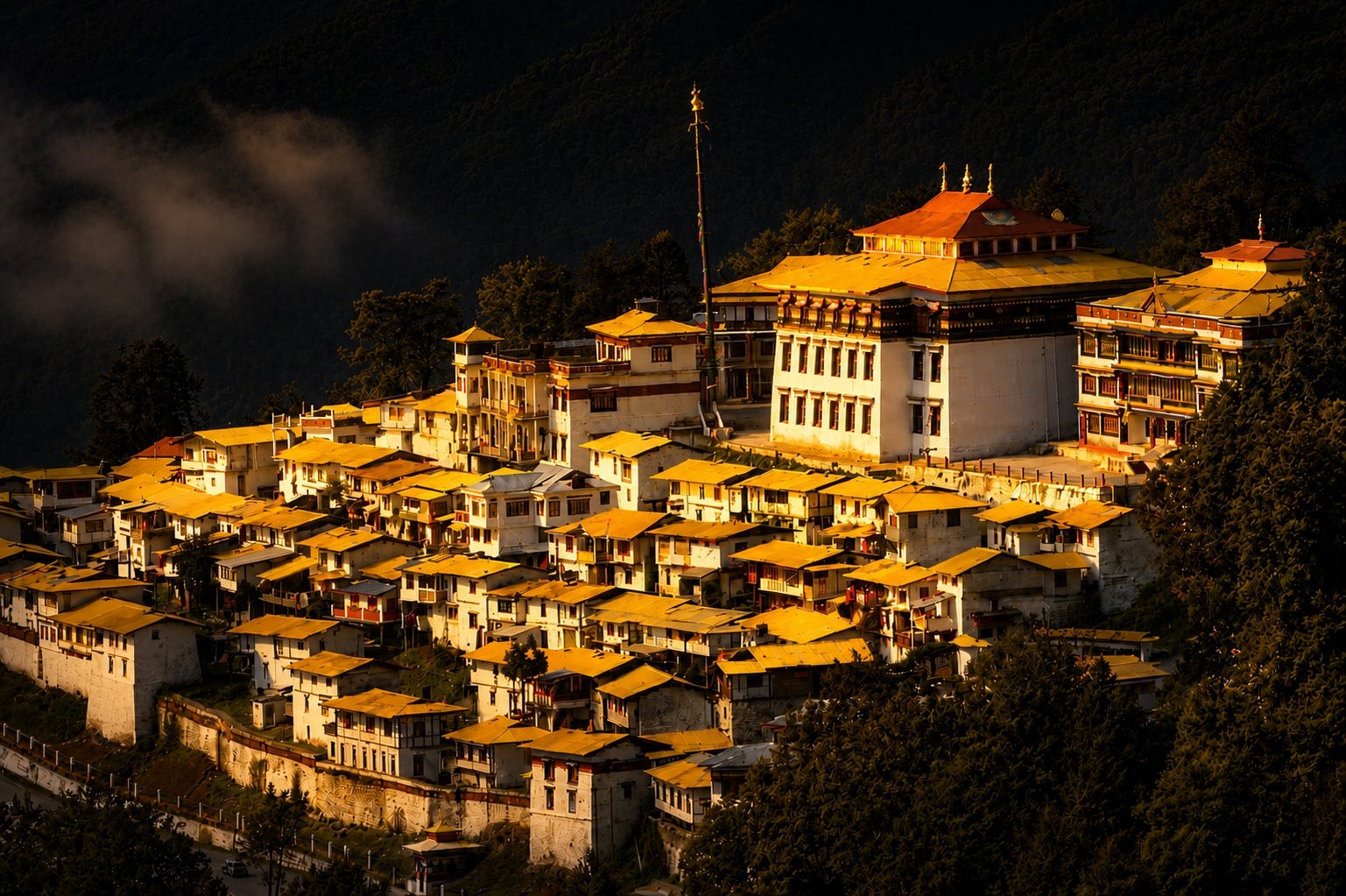
Tawang Monastery
Arrival
“Most visitors cry by the end.” Naib Subedar Manpreet Singh delivered the warning without sentiment, as though he were commenting on the weather.
We were standing at the Nyukmadung War Memorial in Arunachal Pradesh, a windswept outcrop of stone and memory suspended above the road to Tawang. Behind him, mountains rose in successive ridgelines toward the horizon, each range fading into a paler shade of blue until the distinction between earth and sky seemed largely theoretical. Somewhere below, invisible among folds of terrain, a convoy moved with modern certainty, while the ridge above remained governed by an older and harder calculus of endurance.
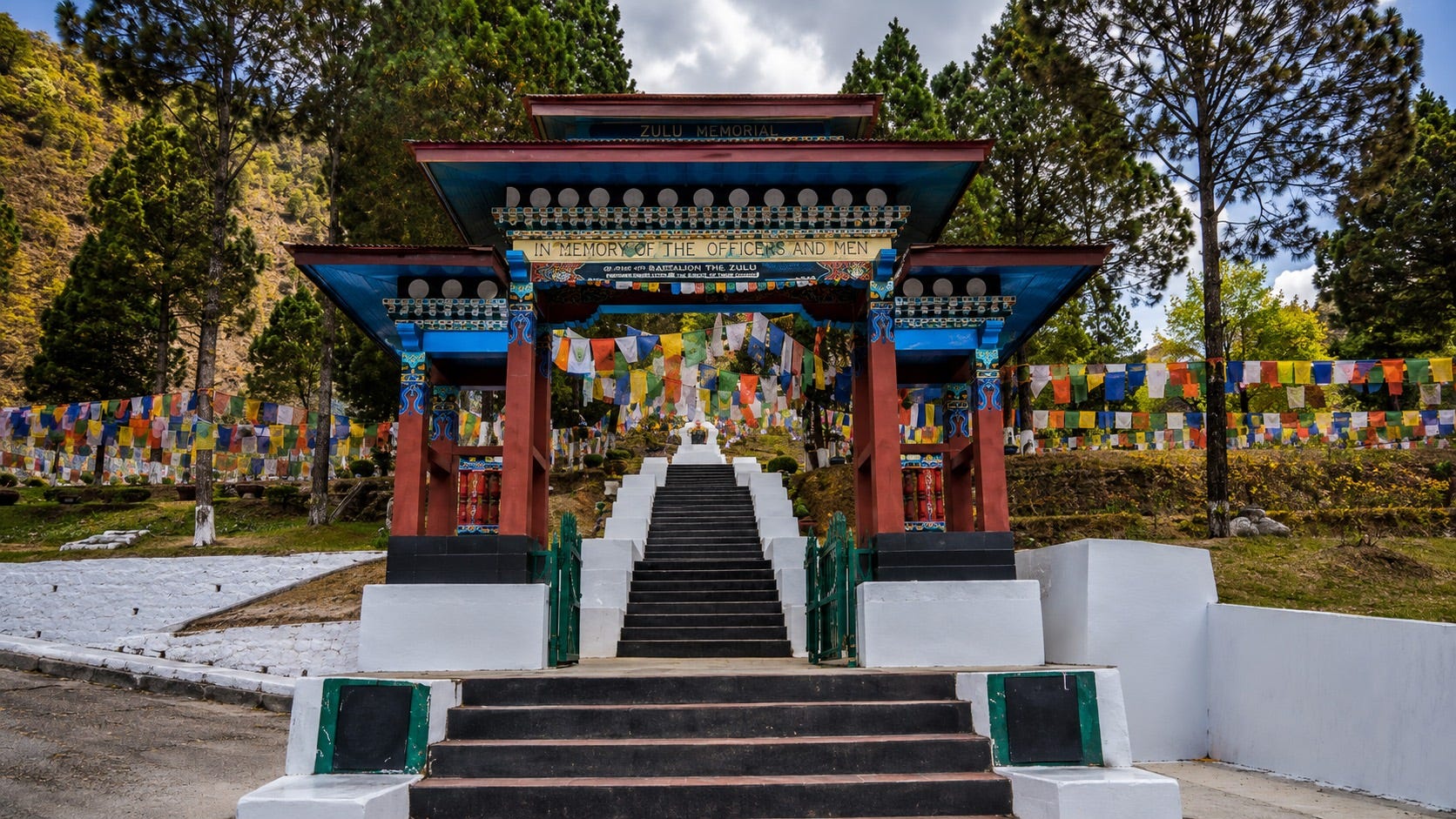
Nyukmadung War Memorial
The memorial itself was immaculate. Clipped lawns, polished plaques, exhibits arranged with the orderly precision of military institutions. The war had not left the mountains. His remark stayed with me. Only later, at Se La, trying to imagine my own battalion scattered across those frozen heights six decades earlier, would I understand what he meant.
My journey had begun several hundred kilometres away, in Guwahati, though it feels more accurate to say it began much earlier. The flight from Bengaluru landed shortly after noon. Stepping into the new terminal at Lokpriya Gopinath Bordoloi International Airport, my eyes kept reaching for a Guwahati that existed only in the years I had been posted here, and kept closing on something newer. The new terminal had taken its patterns from the hills outside and enlarged them past the point of resemblance, the way a state quotes its own past once it is sure of itself. Outside, the road wore fresh tar.
Deka, the young Assamese driver, was waiting beside the vehicle that would take me to Missamari. Deka drove the way men do on roads they expect to outlive, leaving margins the traffic kept eating into. ‘Four lanes soon, sir,’ he said at a stretch that was still one.
The road to Missamari runs through landscapes that have witnessed more history than their quiet appearance suggests. Today the town sits unobtrusively at the foothills of the eastern Himalayas, in Assam’s Sonitpur district, one of countless settlements scattered across India’s vast geography. In 1959, thousands of Tibetans fleeing Chinese rule crossed into India through these regions. Among them was the Fourteenth Dalai Lama. Long before strategic analysts began discussing the Himalayas as a geopolitical theatre, these valleys had already become corridors through which the destinies of nations moved. Missamari itself wore the familiar atmosphere of a military station. Tree-lined roads, orderly compounds, the reassuring predictability of institutions built to function regardless of circumstance.
My host was the General Officer Commanding, Major General Hardaman Singh Gill, an old friend whose acquaintance stretched back to our cadet days in Sangro Company at the Indian Military Academy. Something about Hardaman had always stood out, particularly the quiet elegance with which he conducted himself.
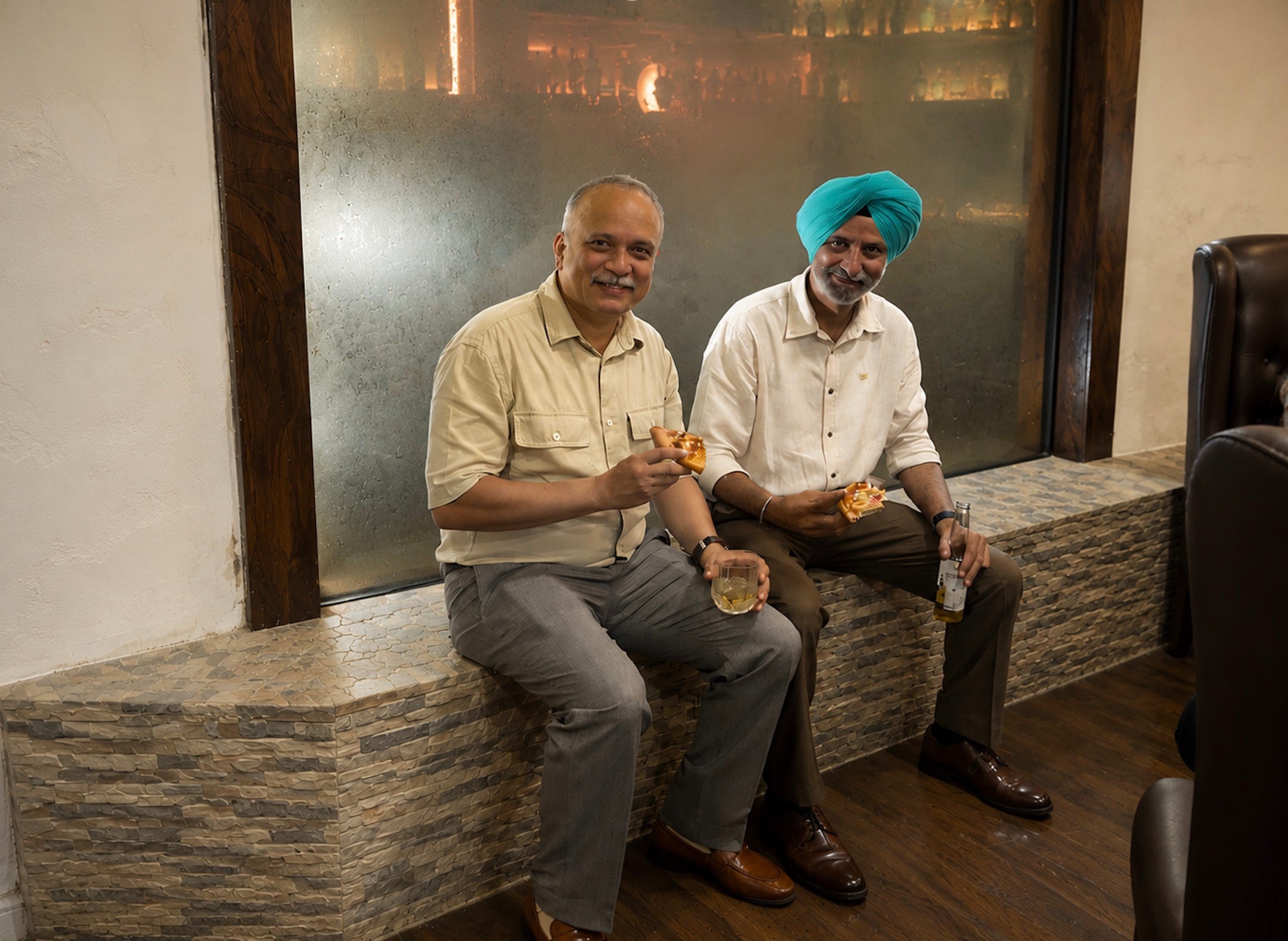
Pizza and drink in a quiet corner of the Officers Institute. Author with Hardaman
Military friendships simply pause. The decades between our cadet days and our reunion in Missamari contained field postings, marriages, children, disappointments, successes. Yet within minutes of meeting, conversation resumed exactly where it had left off. That evening he appeared at my room without warning, much as he might have done three decades earlier, and we slipped into the kind of talk only old soldiers manage, equal parts reminiscence, analysis, and good-natured banter about friends and family. Outside, darkness settled over the foothills. Inside, glasses were replenished and the years receded.
The following morning’s seminar was titled Abhedya Gyan - Invincible Knowledge. I had been invited to present papers on the intersection of technology, information systems and human cognition in modern warfare. What stayed with me was not the breadth of expertise but the absence of complacency. Officers moved between military history, psychology, network theory and emerging technologies, and arrived, often, at different conclusions. The most illuminating moments came not from consensus but from disagreement. The questions were sharp, occasionally uncomfortable, always thoughtful. The Saturday social evening at the aptly named Bob Khating Institute gave me a glimpse of the flat social hierarchy the formation’s leadership had carefully fostered.
Among the speakers was Major Vineet Kumar of the Territorial Army, founder and Global President of Cyber Peace Foundation. Travelling with Vineet would become one of the unexpected pleasures of the journey. The first time I met him he was a teenager who insisted on calling me “Uncle,” long before cybersecurity became fashionable. He was an exceptionally bright boy with an instinctive grasp of cyberspace and a mind that reached emerging technologies before most adults knew they existed.
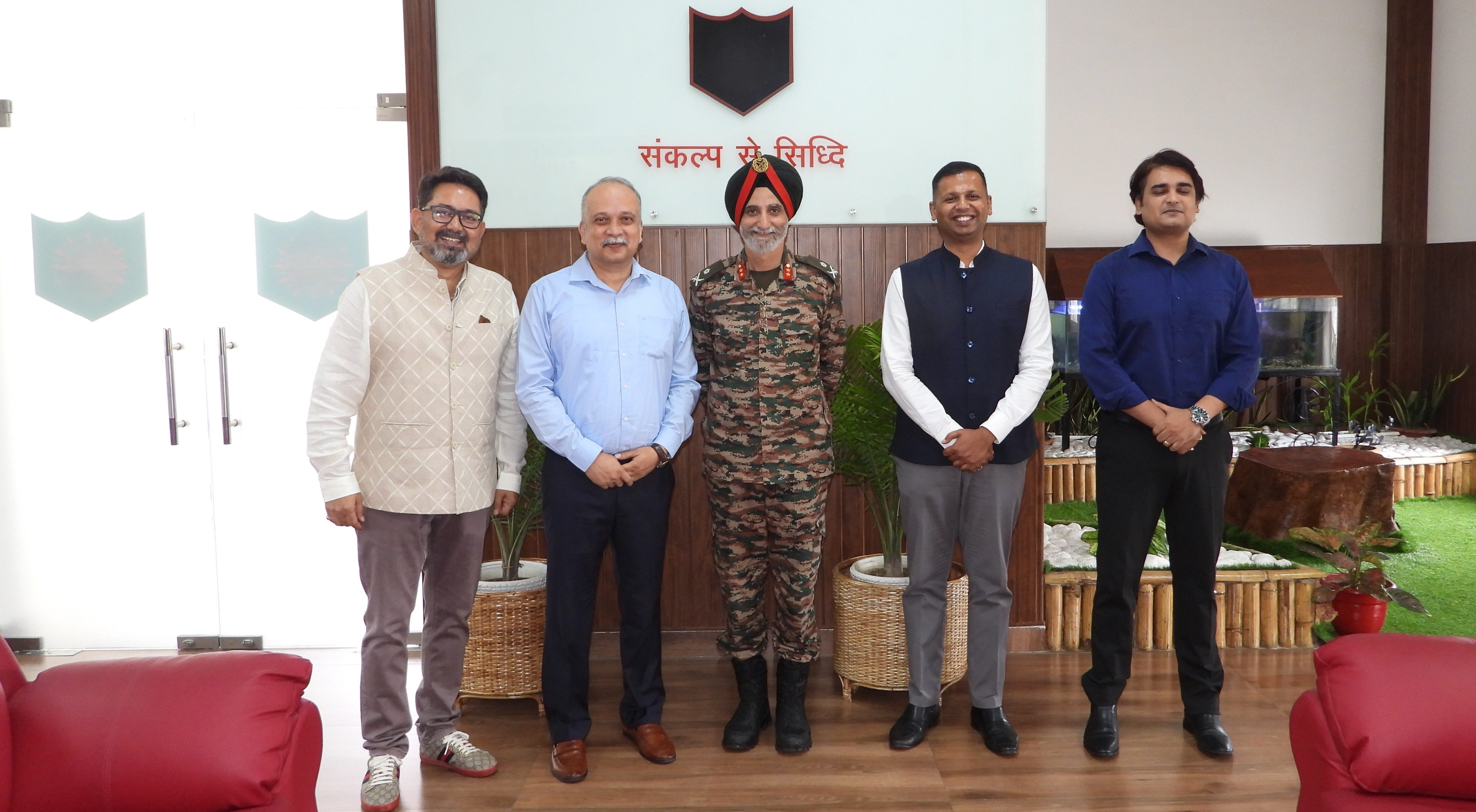
L to R - Col Shashank Kaushal (R), Author, Maj Gen HS Gill, Maj Vineet Kumar, Ishan Sinha
Roads Into Memory
The next morning, Vineet and I left Missamari for the mountains. Three hundred kilometres elsewhere is an afternoon. Here it is a negotiation. The road does not cross the mountains so much as ask their permission, and the rivers, the weather and the occasional landslide reserve the right to refuse.
The road to Tawang is less a highway than a gradual ascent through several worlds. We climbed out of the tea and the heat by degrees. The sal stood taller and then stopped trying; bamboo crowded the cuttings; the windows fogged at the edges. The horizon, which on the plains had been a rumour, moved in close enough to touch. As the vehicle climbed, conversation moved from technology to geopolitics and back again, and somewhere beyond the Assam-Arunachal border the landscape began exerting that influence large mountains have on people. The small freight of a working day, the unanswered mail, the half-finished argument, became inaudible, the way a voice does next to a river.
We stopped at Bomdila for lunch with officers of the Arunachal Scouts. The regiment holds a singular place in the military ecosystem of the Northeast. Drawn largely from local communities, its soldiers carry an intuitive understanding of terrain, culture and climate that no amount of formal training can fully replicate. The Commanding Officer, Colonel Parikshit, welcomed us warmly and talked for the better part of an hour about tribal identities, infrastructure, demographic shifts and border management. A state remaking itself from tribal dynamics into modernity, and not yet willing to let go of what it had been.
After lunch, Parikshit suggested a short detour. A few minutes later we stood before a memorial to the soldiers of the 1962 war. The transition was abrupt. One moment we had been discussing contemporary challenges, and the next, names carved into stone. Military memorials have a distinctive emotional architecture. Unlike civilian monuments they rarely reach for grandeur. Their power lies in restraint. A name, a date, a regiment, a brief description of events.
Another generation of officers had travelled these roads under very different circumstances. Most had arrived believing they were defending a newly independent nation. Few could have imagined the scale of the disaster waiting for them. The war of 1962 occupies an unusual place in Indian consciousness.
For soldiers the war exists not as a geopolitical event but as a collection of individual stories, the units, deployments, actions, valour and losses. My own battalion, 4 Sikh Light Infantry, had been among the formations deployed in the Se La sector. Poorly equipped, inadequately clothed, expected to hold terrain that would challenge a modern army, they paid a terrible price.
The casualty figures are easy enough to quote. One hundred and fifty-eight dead, including the Commanding Officer and the Second-in-Command. Dozens more missing, wounded or captured.
We reached Dirang as evening approached. Nestled beside the Dirang Chu, the town seemed suspended between mountain and river. The late light softened everything it touched. Our accommodation was at a Sapper camp overlooking the valley, where I was greeted by Subedar Choohar Singh of the Sikh Light Infantry. When I said I had last served with the regiment two decades earlier, the surprise was visible. He asked my battalion, and slowly repeated the number. A regiment links generations who never met. It turns history from an abstraction into something personal.
After dinner I stepped outside alone. The Dirang Chu flowed through the darkness below, catching occasional fragments of light before disappearing again into shadow. I stood and let it run. It had been doing this before the road, before the war, before the regiment, and it accommodated none of them.
The next morning dawned cold and clear. We resumed the climb through conifer and rhododendron. Waterfalls appeared beside the highway, tumbling down rock faces polished by centuries of meltwater. Every turn revealed another valley, another ridge, another landscape somehow larger than the last.
At Nyukmadung we stopped. This was where I first met Naib Subedar Manpreet Singh of the Sikh LI. From a distance the memorial looked modest. Up close it seemed larger. Manpreet delivered his briefing with the practised cadence of a man who had repeated it countless times, yet repetition had not dulled it. As he spoke, the war stopped feeling remote. Distances became tangible, decisions acquired consequences. More than six decades had passed. The officers and soldiers who fought here were gone, and India had changed almost beyond recognition. The presence of the dead felt palpable. When the visit ended he walked me to the visitors’ register, and then came the remark. “Most visitors cry by the end.” At the time I smiled politely. I would spend the next several days discovering why.
Above the Tree Line
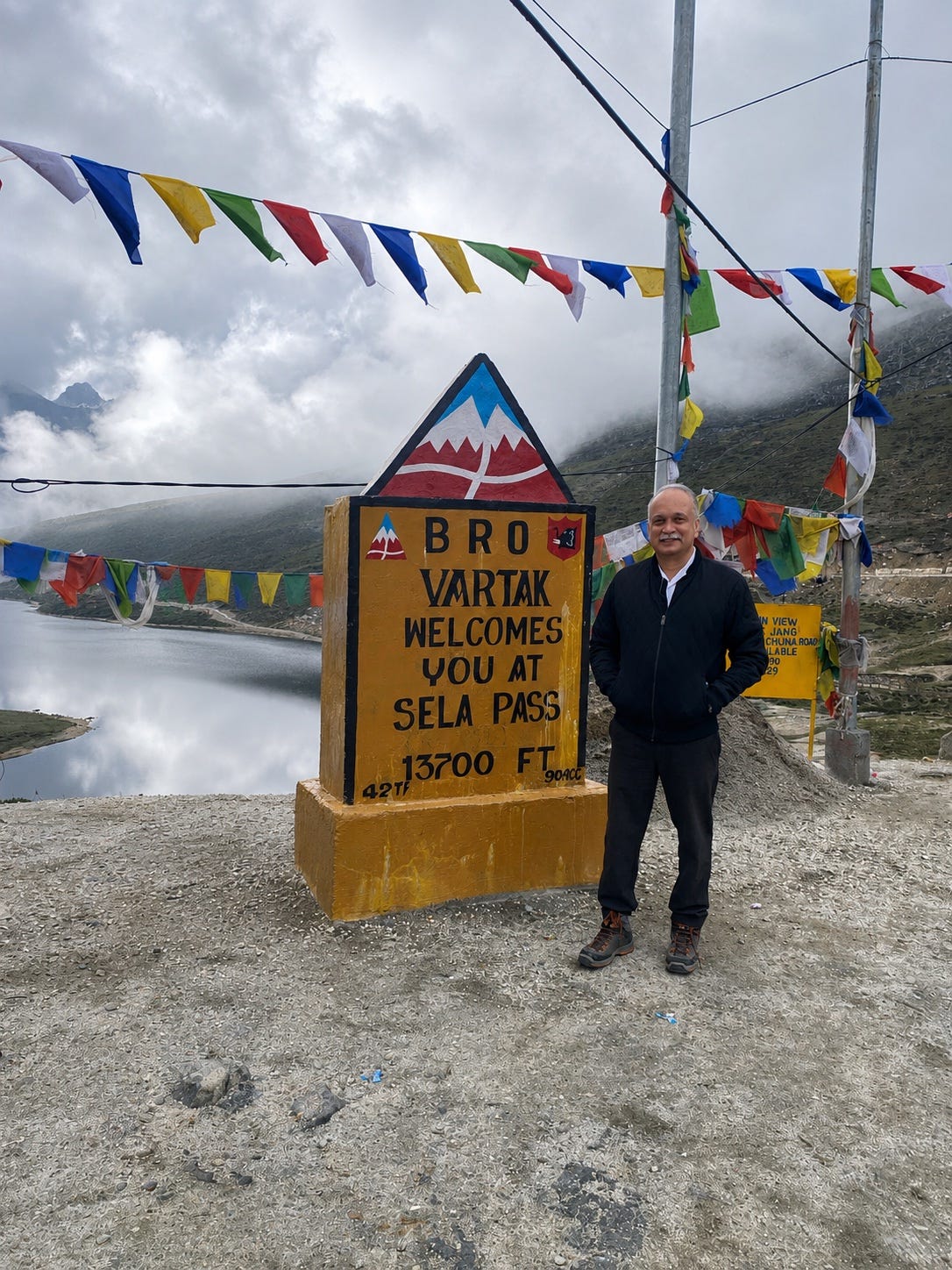
Author at Se La
Beyond Nyukmadung the road began its final ascent toward Se La, and with it came the sensation of leaving behind not one landscape for another but one scale of existence for another altogether.
The forests thinned. The trees, which only hours earlier had crowded the mountainsides in dense ranks, grew smaller and more widely spaced, then disappeared. The road climbed into a world of rock, wind and sky. Distances turned deceptive. Peaks that looked close enough to touch stayed hours away. Valleys opened beneath us and vanished around the next bend.
In a city you can believe the order is permanent; the buildings vouch for it. Up here nothing vouches for anything. The road exists because a detachment maintains it, the bridge because someone re-decks it after each thaw, the post because trucks reach it before the snow. Stop tending any of it and the mountain takes it back inside a season. One can study the campaigns of 1962 in books, examine the maps, weigh the decisions, but only here does the physical reality behind the narrative come clear. Every kilometre I crossed by vehicle meant hours on foot for men carrying weapons, ammunition and supplies through the freezing cold.
Se La appeared without transition. The road simply stopped insisting on continuity. Lines of prayer flags ran from the road to ridge and back, faded on the weather side, snapping where the wind got under them. Lakes lay scattered beneath the peaks and snow lingered in hollows the sun never reached. Above everything rose the immense blue sky one meets only at altitude. The air felt thinner, and each short walk asked slightly more than expected.
Tourists stood where artillery had once been deployed, their cameras set to a light that no longer carried urgency. A small café served tea and instant noodles to travellers grateful for warmth. Nothing in the terrain explained what had happened here. Somewhere among these ridges, men from my battalion had fought, retreated, regrouped and died. Most had been little older than the young officers I now met at institutions across the country. They carried no special awareness that history would remember them. They were doing what soldiers have always done, following orders because circumstances required it.
Nothing marked where they had fallen. The snow or the wind had taken it long ago. I stood where the ground itself was indifferent, and nothing came. I came down the mountain not knowing whether the uniform had worn it out of me or whether it had never been there.
From Se La we continued toward Jaswant Garh. No journey through this part of Arunachal is complete without stopping there. Dedicated to Rifleman Jaswant Singh Rawat of 4 Garhwal Rifles, the memorial sits somewhere between history, legend and regimental sacrifice. Over the decades the story has gathered layers difficult to separate from one another. The legend has outlived every attempt to verify it, because what it preserves, one man holding a ridge against the impossible, is something the regiment, and the country, has decided is worth keeping. What struck me was the atmosphere around it. Visitors lowered their voices, while soldiers moved with deliberateness. Even tourists seemed to sense they had entered a place where remembrance was still an active practice rather than a ceremonial obligation.
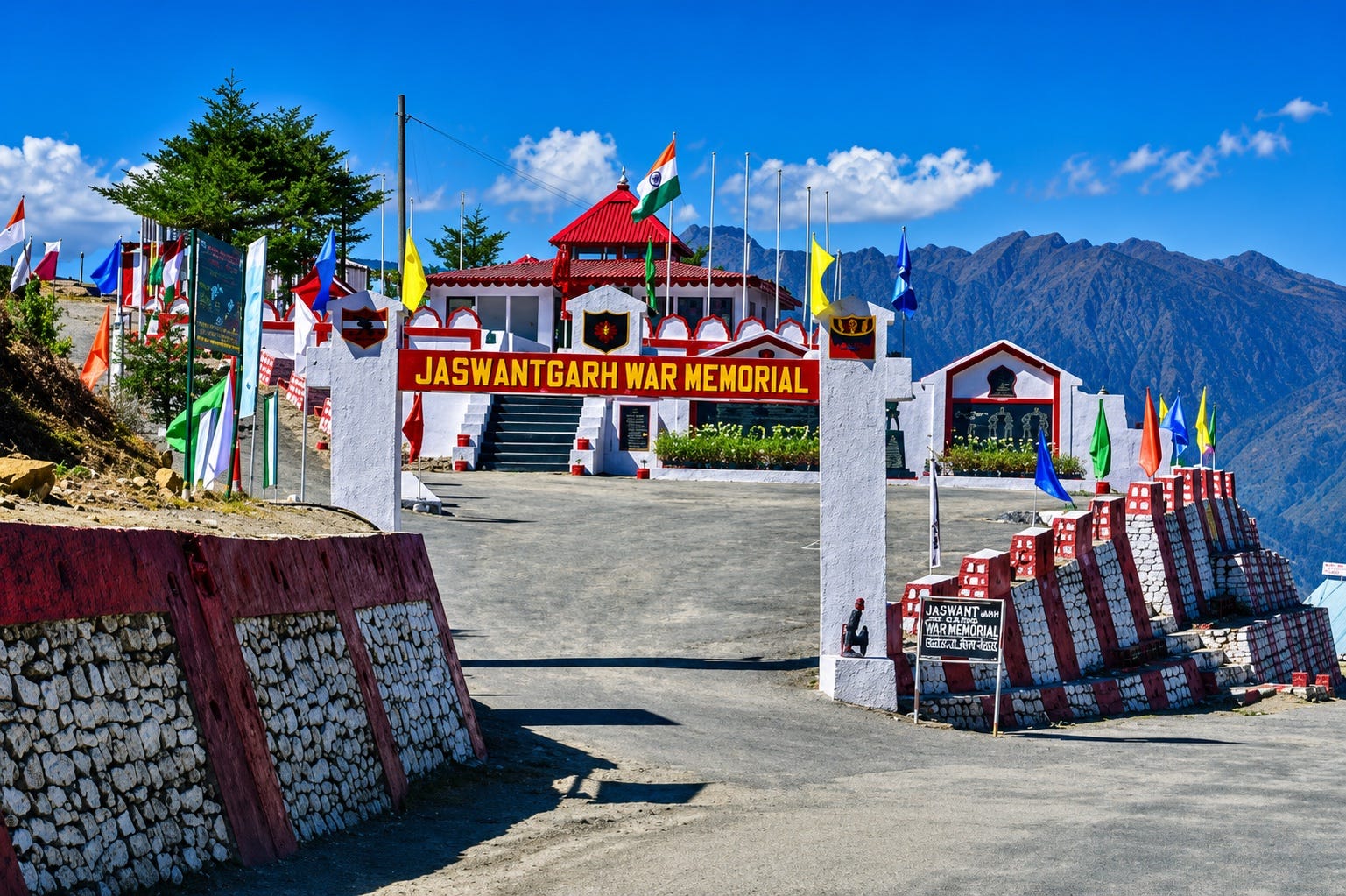
Jaswantgarh - Where legends endure
Where Stories Endure
The descent toward Tawang brought colour back to the landscape. Streams appeared beside the road. Patches of green broke the rock. Settlements emerged, their tin-roofed houses clinging to mountainsides that seemed to offer little encouragement for human settlement.
Tawang occupies a curious position in the Indian imagination. For many it exists mainly as a strategic location, a name in discussions of borders and geopolitics. Arriving there reveals something else. Tawang is a repository of tradition, faith and culture whose significance long predates modern boundaries.
The monastery dominates both the skyline and the imagination. From a distance it appears almost suspended above the valley, its white walls and golden roofs catching the changing light. The next morning Lama Khoji welcomed us with the quiet hospitality common among those who spend their lives surrounded by history. Unhurried, in maroon robes, he narrated the monastery’s origins and the significance of its deities and artefacts. His voice was flat and patient, a man who has explained the same to countless soldiers, ministers and schoolchildren and lost interest in being impressive about it.
As we walked through incense-scented assembly halls, libraries and courtyards, the monastery revealed itself as a vast store of accumulated wisdom. Manuscripts held centuries of learning. Sacred artefacts carried stories that outran the lifespan of any single custodian. One manuscript held my attention. It appeared to be written on the bark-derived handmade paper for which the monasteries of Tawang have long been known, its pages illuminated with bold gold lettering, each character laid down with a steadiness no hurried hand could fake. The script meant nothing to me. What held me was the hand, every stroke laid down at the same unhurried pressure, page after page.
On the road to Sangetsar Tso, more widely known as Madhuri Lake, prayer flags lined the winding mountain roads. Blue, white, red, green and yellow fluttered against the backdrop of mountains and sky. Their purpose was not to hold blessings in one place but to release them into the world, to let them travel beyond the mountains where they were first offered.
What the Frontier Knows
The final morning in Tawang arrived quietly. Light reached the upper ridges first and lingered there, reluctant to descend. Roofs emerged from shadow one by one. Smoke rose from chimneys. There is no surge of movement here, no collective rush toward appointments. The town wakes the way it does everything, without hurry.
Sleep had broken before dawn, on deep rhythmic chants that seemed to set the room vibrating in resonance. I stood at the window and watched the mountains separate themselves from the dark. The previous days had been crowded with impressions, the memorials, monasteries, conversations, rivers and roads, and what stayed was none of these but a question I had carried down from Se La and not managed to set down since. I had gone to the one place that should have undone me, and it had not.
Later that morning, the Be Happy Café at the Old Market proved an unexpectedly revealing stop. It opens at 10:30 am; the wine shop next door opens at nine. Be Happy Café served as a meeting point for a rising generation of Arunachalis. Two women parked their shopping and settled in for the morning. At the next table an argument about a road contract was being conducted at the volume of people who would meet again that evening. A tourist turned his phone to find north. The scene would have been familiar in almost any town in India, and yet it felt distinctly local.
Here I met Yountan Zopa, who moved comfortably between writing, entrepreneurship and community work. Our conversation began with introductions and widened into education, tourism, technology and the future of the Northeast. What struck me was not the content of his ideas, though many were thoughtful, but the ease with which he inhabited several identities at once. Deeply connected to local culture, equally at home with global trends, untroubled by any supposed contradiction between them. He carried his heritage into the future rather than leaving it behind, and seemed to find nothing remarkable in doing so.
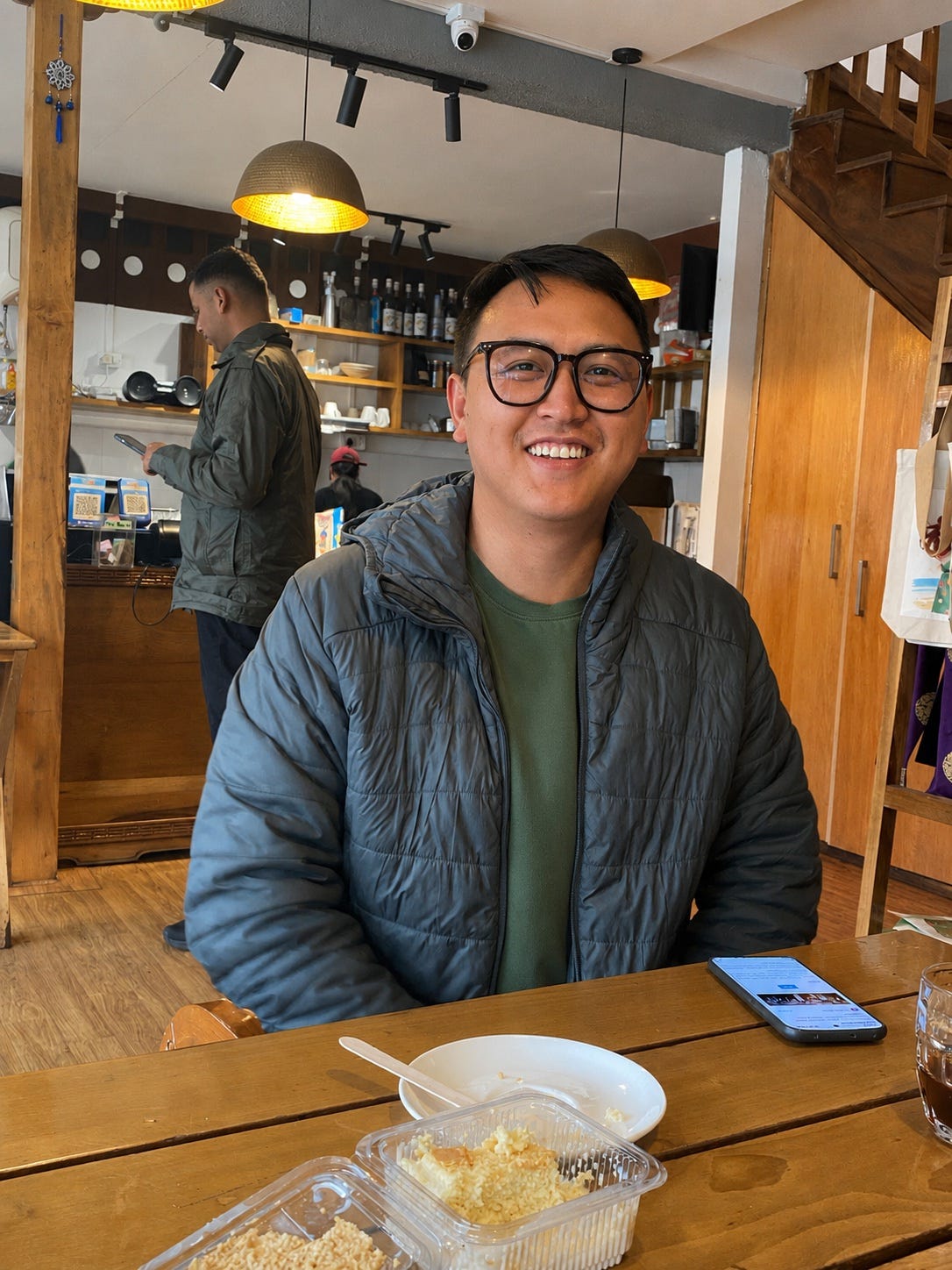
Yountan Zopa - Author, Social Entrepreneur
Later that afternoon I joined Vineet for a walk through town. The streets were busy with visitors, the ordinary rhythms of life continuing beneath the spectacular backdrop of mountains and the Giant Buddha statue visible from all parts of Tawang. A group of women danced in a slow circle near the Old Market Monastery for the long life and health of the Dalai Lama, an everyday devotion with a fresh set of dancers each time. In the evening we watched the Army’s light-and-sound show, the war of 1962 narrated back to us in coloured light and recorded gunfire. Around me, people drew breath at the right moments. A woman wiped her eyes. I watched the staged version do to strangers what the actual ground had failed to do to me.
The return began the following morning. Roads that had seemed unfamiliar days earlier now carried the comfortable familiarity of recently acquired memory. The mountains were exactly as they had been before. I was not.
Back in Missamari, I spent a last evening with Hardaman. The talk ranged across familiar territory, old friends, new technologies, the state of the nation, the future of the Army. He asked, once, how Se La had been. I said it was much as I’d expected, and he let the answer sit a moment longer than it deserved before moving us on to something else. He had spent his whole life in the same profession and would have understood the thing I carried down from the mountain better than anyone else. That was precisely why I did not raise it, and why I suspect he did not either. Outside, the dark came down once more over the foothills, slow and complete.
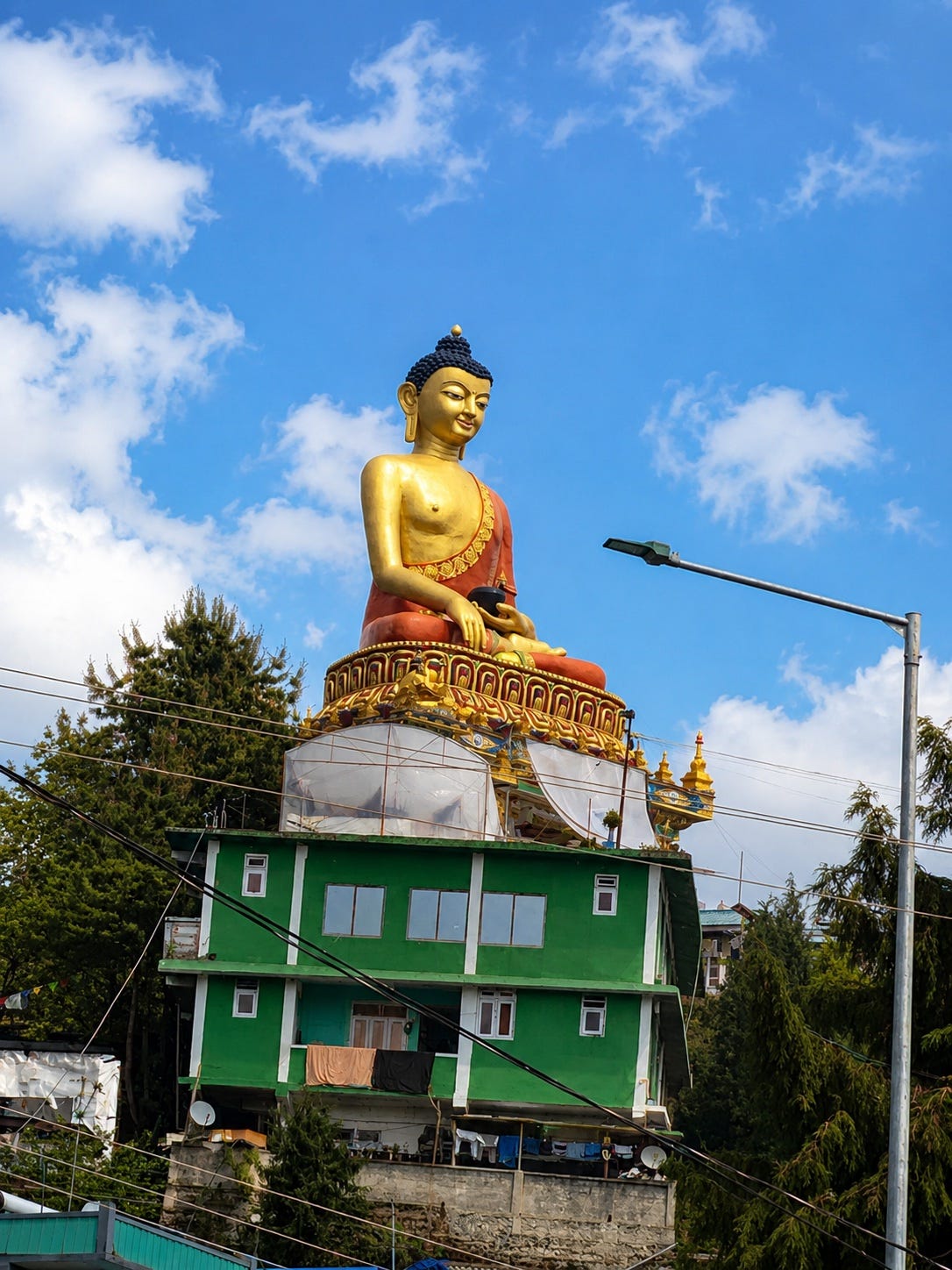
The Buddha that overlooks Tawang
The next day I boarded my flight at Guwahati. As the aircraft climbed above the Brahmaputra Valley and turned westward, my thoughts went back to Naib Subedar Manpreet Singh and his quiet certainty about what the mountains did to people. He had been right about the visitors. He could not have known that the one man on the road with the most reason to weep had stood on the exact ground his battalion died defending and felt nothing turn over.
I could explain the place perfectly. Its monasteries preserve centuries of learning, its memorials preserve sacrifice, while the regiments preserve lineage, and the keeping would go on long after me. The frontier is usually imagined as the line where a nation ends. Arunachal suggests otherwise. It’s the point where a country’s stories begin to disagree with themselves, and where, unlike in the cities, someone is still keeping all of them.
What I could not say was whether anything in me still answered to what was being kept. The mountains remember. I had gone all that way to learn whether I still could, and they declined to tell me.
I truly felt like I was there, each moment, each turn in the road, each breath... what a beautifully articulated story. Thank you for sharing your adventure. Much respect to you.
Very visual narrative. Truly touching